Holger Trahe · Rust developer
Rust, running live in your browser.
WebGPU rendering, WebAssembly toolchains, on-device ML, hardware over USB. Every tile below is a real app — one click, no install, no upload.
Lighting & photometry
13 years in the lighting industry, now in Rust: the GLDF / EULUMDAT / IES toolchain — parsers, editors, terminal UIs and a WebGPU spectral ray tracer.

Eulumdat Editor
LDT / IES / ATLA editor: polar, heatmap, 3D butterfly, isocandela and BUG rating — here two measured LUXEON files compared side by side.

GLDF Editor
Open, inspect and author Global Lighting Data Format files — or script them: one AutoLISP script builds a four-variant product, then flies the 3D room, tilts the heads and swaps the housing colours.

Greenhouse Spectral Lab
Spectral Monte-Carlo trace of grow-light spectra and canopy PPFD in a glasshouse.
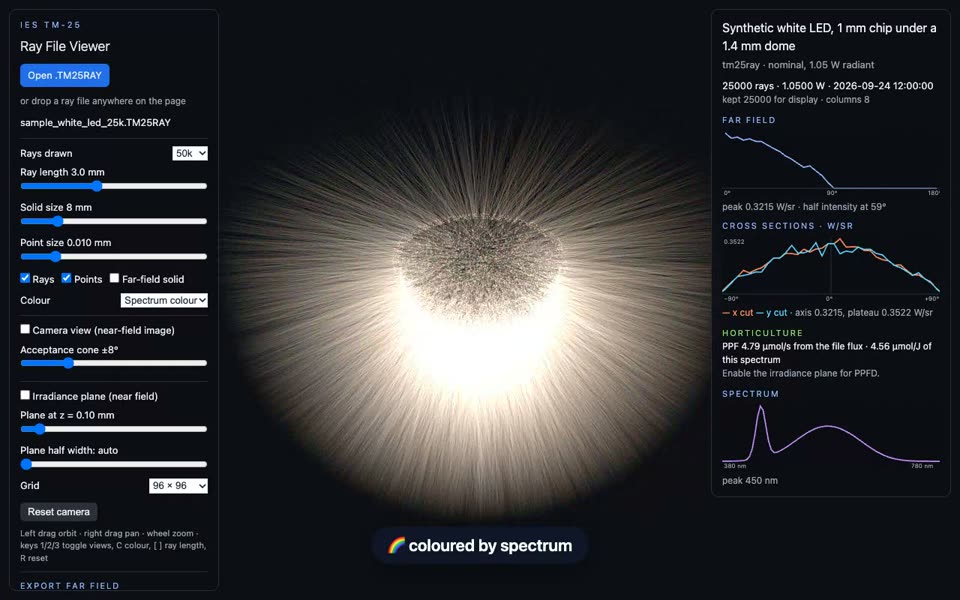
TM25RAY viewer → virtual goniometer
IES TM-25 ray files in WebGPU, handed straight to the virtual goniometer — near-field data that keeps the real emitting area, for covers, reflectors and close-range calculation.

RAPIDcalc for Deko-Light
Pick a luminaire, describe the room, get a lighting layout — product to order in four steps.

Eulumdat in the terminal
The same library as a ratatui app: polar, cartesian, heatmap, cone and butterfly diagrams drawn in text cells, C-planes stepped by key.

GLDF editor in the terminal
gldf-edit: the GLDF editor's reducer behind a ratatui front end — photometry, spectra, an orbitable L3D model, rc-3/rc-4 validation.
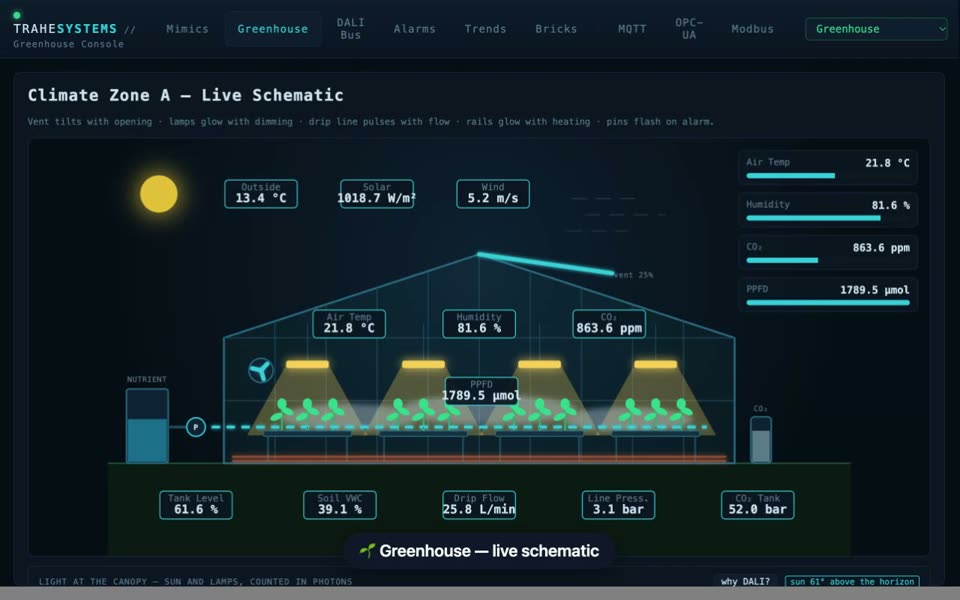
TRAHE SYSTEMS — Greenhouse Console
Industrial SCADA in a browser tab: live mimics, alarms, trends, MQTT, OPC-UA, Modbus — and a real DALI bus through plantworks-gw — my own Embassy Rust MQTT ⇄ DALI gateway firmware on an ESP32-C6, connected over USB (WebSerial).
Open the console ↗Embedded Rust: one codebase, chip and browser
geodb-rs firmware on Embassy: a 216 MHz Cortex-M7 (STM32F769I-DISCO) keeps 49,264 cities in flash and renders a software globe on its LCD. The exact same firmware code runs below as WebAssembly — or connect it to a real board and your touches move the device. ESP32-P4 too.

The firmware, in your browser
The board's own code — flash image, queries, software globe, the whole 800×480 screen — compiled to WebAssembly. Drag, tap, zoom like on the LCD.
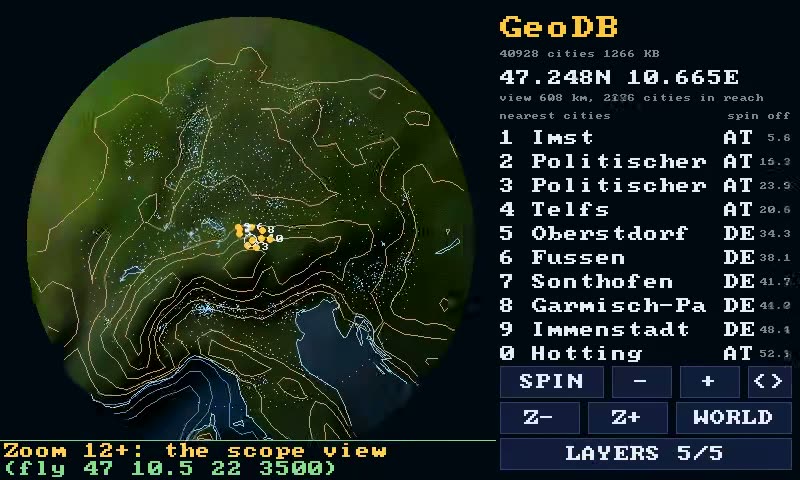
On the board
Straight from the STM32F769I-DISCO's 800×480 LCD: a scripted tour — layers, relief, fly to Munich, Sydney, Rio, zoom to contours.

GeoDB Globe — browser edition
Starts at 274 KB, then loads what you ask for: 153,312 cities, country facts, 19 languages, 16K satellite or baked 1:10m coasts — compared side by side. Radius search in a WebGPU compute shader.
BIM / IFC
A pure-Rust IFC parser with WebGPU rendering — open real building models straight from a URL.


AutoLISP, 1991 → today
In 1991 AutoLISP turned CSV lists into electrical schematics on a 486 at Elektrotechnik Trahe GmbH. acadlisp is that interpreter again, in Rust and WebAssembly — and the scripting engine inside the GLDF and IFC editors.

acadlisp — AutoLISP in Rust
An AutoLISP interpreter and mini CAD engine: the 1991 CSV → template → schematic workflow, 50 drawings in the browser, a step debugger, DXF R12 and KiCad export.

AutoLISP inside the IFC viewer
bimifc.de's REPL: a Lisp script writes an IFC — walls, slabs, columns, hip roofs — draws the plan, then hands it to the WebGPU viewer.
On-device ML & health
Inference with Burn, entirely client-side. No upload, no server — the data never leaves the page.
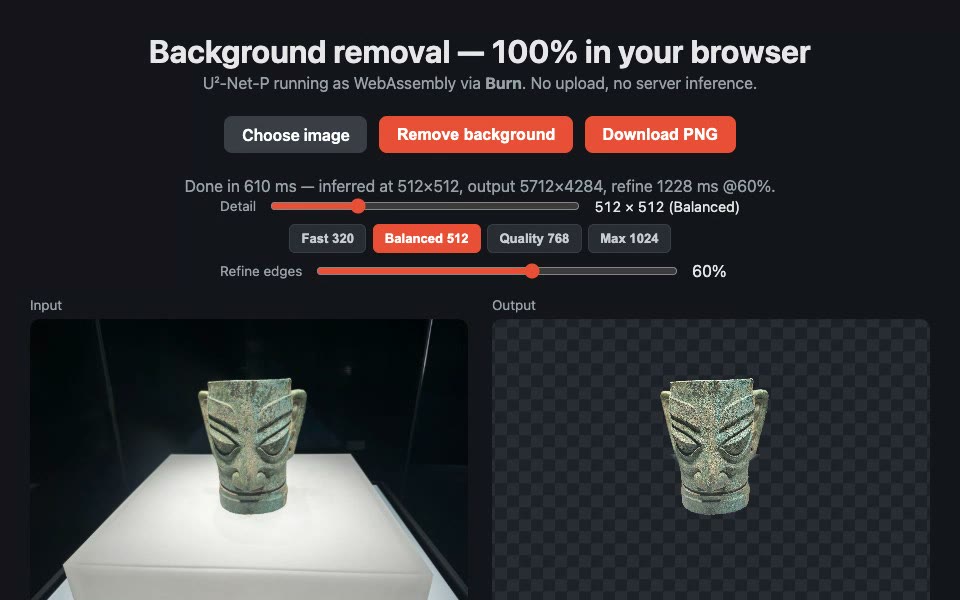
Background removal
U²-Net running as WebAssembly via Burn. Drop an image, get a cut-out.

Panoramic findings
Research prototype: dental radiograph analysis computed on the device.
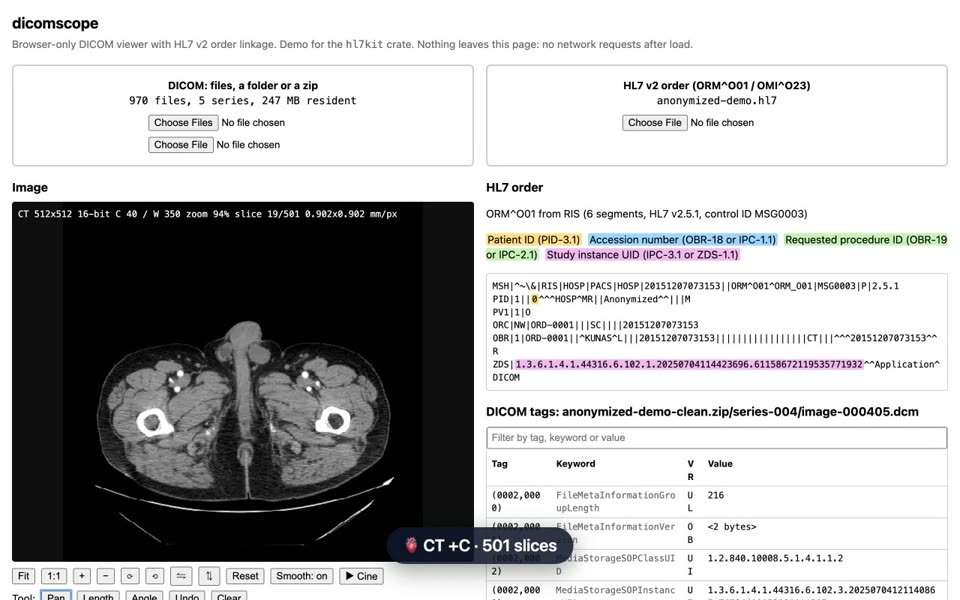
dicomscope — DICOM meets HL7 v2
970 CT images and an HL7 v2 order read in the browser, linked by Study Instance UID and mapped to FHIR. Demo for the hl7kit crate.
Just for fun: Rusterando
A self-hostable restaurant platform in Rust — menus imported server-side, ordering, delivery zones, QR menus.

